









Belarus in the Crosshairs: What Zelensky's Ultimatum Really Means for the CSTO
As Ukraine threatens to destroy Russian relay stations on Belarusian soil, analysts warn the crisis exposes the hollow core of post-Soviet collective security
28 June 2026
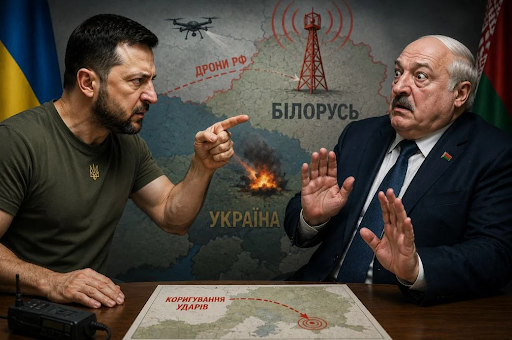
On June 19, Ukrainian President Volodymyr Zelensky issued a blunt warning to Minsk: dismantle the Russian relay stations on Belarusian territory being used to guide drone strikes on Ukrainian cities — or Ukraine will destroy them itself. Zelensky said he had specific intelligence on four such facilities located in the Brest and Grodno regions, and gave Belarus one week to act. The deadline expired on June 26.
Minsk did not publicly respond. Moscow called Ukraine's warning an encroachment on Belarusian sovereignty. And the region held its breath.
Then, on July 22, Zelensky offered a partial update: the relay stations appeared to have gone quiet. But he was careful not to declare victory. "Whether they have been dismantled, I don't know yet," he said. "But we are working on it and monitoring the situation very closely — I receive daily reports." The equipment, he acknowledged, could be switched back on at any moment. The problem had been paused, not solved.
Beneath the tactical drama, however, a deeper question was gathering force: what does any of this mean for the Collective Security Treaty Organization — the post-Soviet military alliance that, on paper at least, obligates its members to come to each other's defense?
The Alliance Nobody Wants to Test
Belarus is a member of the CSTO, the Russian-led bloc that also includes Armenia, Kazakhstan, Kyrgyzstan, and Tajikistan. The organization's founding logic mirrors NATO's Article 5: an attack on one is an attack on all. The relevant provision is Article 4 of the 1992 Collective Security Treaty. If Ukraine were to strike Belarusian territory, Minsk could invoke that clause and formally request military support from its allies.
In theory. In practice, the picture is far murkier.
Alexander Otroshenko, a Belarusian analyst, journalist, and democratic activist based in Warsaw, points out a damning precedent: Russia itself has never once invoked the CSTO during its war against Ukraine — not even when Ukrainian forces crossed into Russia's Kursk region in 2024.
"At that moment, all the formal conditions for appealing to CSTO allies were present," Otroshenko told Pressklub.az. "But it didn't happen. Russia presents itself as a military superpower and the principal military donor of the CSTO. Asking Kazakhstan, Kyrgyzstan, or Tajikistan to defend Kursk would not just have looked humiliating — it would have raised an obvious question: if Russia is dragging us into a war it started and got bogged down in, what kind of stability and security donor is it?"

The CSTO's credibility gap, he argues, has already been tested and found wanting — most visibly in the South Caucasus. For years, debates about whether NATO members would honor Article 5 commitments have been a staple of Western strategic discourse. The CSTO equivalent of that question, Otroshenko says, has already been answered empirically.
"If anyone thinks CSTO allies are prepared to defend one another, I would recommend buying a plane ticket to Yerevan and asking Armenians how it works in practice."
Armenia's experience is the starkest case in point. When Azerbaijan moved to retake Nagorno-Karabakh — territory Yerevan had long claimed — the CSTO was nowhere to be found. The alliance's silence was deafening, and Yerevan has since moved to suspend its participation in the organization.
Lukashenko's Unenviable Position
The irony is not lost on Otroshenko. For years, Alexander Lukashenko had allowed himself openly contemptuous remarks about Armenia's predicament — the way Yerevan had found itself exposed and friendless when it mattered most. Now, he says, Lukashenko faces a situation that is, if anything, more precarious.
"He risks being left alone with a wounded but very angry Ukraine," Otroshenko said. "Ukraine is, without question, Europe's most battle-hardened military force — and it has a very long list of grievances against Lukashenko: providing territory for Russia's initial invasion, the Bucha atrocities that were made possible in part by that access, the relay stations Zelensky has been talking about, Belarusian industry working for the Russian military-industrial complex, Ukrainian children removed from occupied territories and subjected to anti-Ukrainian ideological treatment with the participation of Belarusian authorities."
Russia's ability to protect its ally, Otroshenko adds, is genuinely in doubt. "Russia cannot even protect critical infrastructure on its own territory. Both Lukashenko and Putin fear not only the humiliation of asking for help, but the prospect of receiving a refusal — delivered in suitably vague and evasive language, of course."
His conclusion about the CSTO's future is unsentimental: the bloc will survive, but only as a paper construct. "Everyone understands their role. The organization allows Russia to present itself as a real superpower with satellites. And it gives those satellites a channel for maintaining ties with Moscow, along with a promise of police and punitive support if popular unrest breaks out at home. Nobody expects it to function as a genuine military alliance."
The Harder Legal and Strategic Questions
Gaziz Abishev, a Kazakhstani political commentator, urges a more measured reading of the situation — one that resists the temptation to dismiss the legal complexities out of hand.

"This is not such a simple topic for discussion," he told Pressklub.az. "If we want to conduct an independent analysis, we need a cool-headed approach. Mockery — from analysts on either side — is not appropriate here."
His core point: Belarus is a CSTO member state, and a strike on Russian relay stations located on Belarusian soil will, almost certainly, be interpreted as an attack on Belarus. That creates a genuinely difficult situation for every CSTO member, whatever their private inclinations. "A treaty is a treaty," he says simply.
Abishev draws a careful distinction between how the CSTO handled the Nagorno-Karabakh conflict and how it would be obliged to treat any Ukrainian strike on Belarusian territory. When Kazakhstan joined the CSTO alongside Armenia in 1994, it was made explicit that the mutual defense clause applied only within internationally recognized borders — which meant Astana was effectively backing Azerbaijan's territorial integrity, not Armenia's claims. Any Azerbaijani military action on Azerbaijani soil to restore its sovereignty was, by that logic, outside the scope of CSTO protection. That ambiguity allowed member states to sit on their hands.
The Ukrainian-Belarusian case is different in structure. Belarus is not a party to the war. A Ukrainian strike on its territory would not fall into the same legal gray zone. "The situation will be quite sensitive and will generate a number of questions," Abishev says.
A Logic That Cuts Both Ways
What makes Abishev's analysis particularly pointed is his willingness to follow the underlying logic wherever it leads — including toward uncomfortable conclusions for Ukraine's supporters.
If Ukraine has the right to strike infrastructure on Belarusian territory on the grounds that it is being used against Ukrainian security, he asks, does that principle apply universally? "If we accept this logic, we have to acknowledge that all countries have such a right. And then the situation can be turned around to suggest that Russia's concerns about NATO infrastructure approaching its borders also have some basis."
The Baltic states, Finland, Ukraine, and Georgia have all insisted that hosting NATO military infrastructure is their sovereign right. Russia has long argued the opposite. Both NATO and Russian doctrine formally designate each other as potential adversaries. Abishev is not endorsing Russia's position — he is noting that the underlying legal principle, once accepted, does not stay neatly contained.
He extends the analogy further. "If you consider any non-lethal reconnaissance or radar infrastructure to be enemy infrastructure, do you have the right to destroy it on the territory of the country where it's located? You could use the same logic to argue that the CPC pipeline carrying Kazakhstani oil through Russian territory should be destroyed — because it brings revenue to the Russian budget that pays for weapons."
The escalatory risk, he argues, is real and should be taken seriously even by those sympathetic to Ukraine's position. Russia, he warns, could use a strike on Belarusian territory as a pretext for justifying strikes against Baltic states — on the grounds that weapons are being supplied to Ukraine from there.
His bottom line is precise rather than evasive: two scenarios must be distinguished. In the first, the relay stations are purely Russian military assets, recently installed, with no Belarusian ownership or operational involvement — but any strike would still affect Belarusian territory. In the second, the stations have been formally integrated into the Belarusian military structure. "That is where the difference lies," Abishev says. "And it matters enormously for how any strike would be legally and politically characterized."
What the Crisis Actually Reveals
Strip away the legal architecture, and what remains is a picture of an alliance system under profound stress — and a regional order in which the gap between formal obligations and practical reality has rarely been so visible.
The CSTO has not collapsed. It probably will not. But the Belarus relay station crisis has demonstrated, once again, that the organization's Article 4 commitments carry the same weight in a genuine emergency that they carried when Armenia needed them: very little. Russia will not ask its allies to fight. Its allies will not volunteer. The mutual defense clause will remain in the treaty text, honored in silence.
For Lukashenko, that is not an abstract problem. He has made his choices — providing his territory as a launch pad for the invasion, allowing Russian military assets to operate on Belarusian soil — and now faces the consequences largely alone. Russia is too stretched across its own front lines to spare significant forces for the defense of Belarusian relay towers. The CSTO will offer diplomatic cover but not soldiers.
Zelensky's ultimatum, whether or not it achieves its stated aim, has done something else: it has forced a public reckoning with just how hollow post-Soviet collective security has become. The relay stations may have gone quiet for now. The deeper question — what any of these alliances actually mean when tested — is considerably harder to switch off.


