










Day Two at Wimbledon 2026: Swiatek Holds, Paolini Fights Back, and a Queen Returns to Her Palace
From Swan's emotional comeback story to Anisimova's measured dominance, the second day at SW19 delivered drama in every corner of the draw — with the best still to come.
30 June 2026
There is always something slightly disorienting about Day Two at Wimbledon. The first round is never finished, the seedings are still theoretical, and the draw has yet to declare its true shape. But the lawns are green, the crowds are expectant, and somewhere across those 18 outside courts, half a dozen matches are always hurtling toward conclusions that nobody quite predicted.
Tuesday delivered on that promise — several times over.
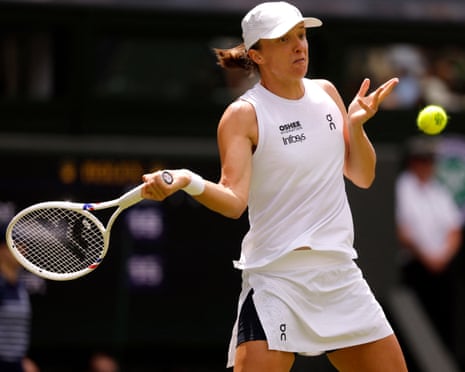
Swiatek Settles In
The defending champion's opening match against Taylor Townsend was never going to be straightforward. Townsend's gameplan was transparent from the first game: take the ball early, compress the rally, apply pressure before Swiatek could build any rhythm. She held to 1-0 and quickly reached 0-40 on the Swiatek serve, which was — for a moment — genuinely unsettling.
Swiatek rallied with three consecutive first serves to reach deuce, then saved the advantage point, too. She eventually held after fighting off five break points across the opening exchanges. It was edgy, scrappy tennis — but then she broke for 2-1, and something clicked. The muscle memory of a champion, perhaps, reasserting itself under duress.
It would be too easy to say Swiatek belongs on grass. Last year's title was a surprise to many, even if it was, in retrospect, logical: the ball bounces low, excellent footwork matters on slippery surfaces, and her baseline geometry is ruthless enough to function on any texture. But the field is improving, and her demolition at the hands of Marta Kostyuk in Paris was a reminder that nobody's position at the top is permanent. If she hits her best level here, she is capable of retaining. That is not the same as saying she is likely to.
Paolini's Heart
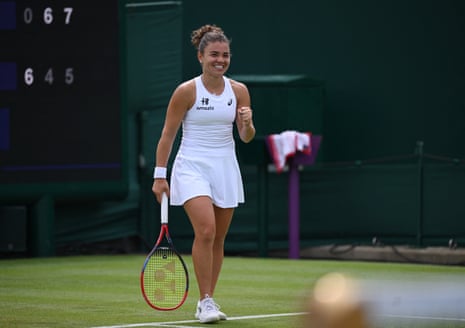
On Court 12, Jasmine Paolini produced the kind of match that confirms why she is one of the most compelling players in the draw. She lost the first set to Robin Montgomery 6-0. A double-bagel was briefly in view. Then she broke for 4-4 in the third, held for 5-4, reached match point at 30-40 — only to telegraph a backhand at the net, allowing Montgomery to hit into space and save herself.
Eventually, Paolini closed it out 0-6 6-4 7-5, but not before the match had twisted through four or five separate narratives. The Italian contingent in the crowd — described by one observer on site as "bare Italians, all whooping and hollering" — were doing their part throughout. Montgomery, just 21, played with real quality and heart; she will return. But Paolini has the composure of a player who no longer fears losing the thread.
Katie Swan and the Long Road Back
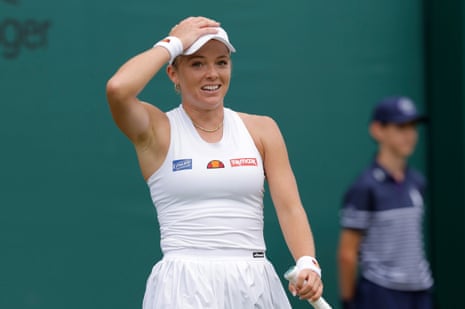
Then there was Katie Swan.
Beating Irina Begu 6-4 6-4 to become the first British player into the second round was not, in itself, a seismic result. But context is everything in sport. Not long ago, Swan was unranked, injured, and seriously considering whether the sport was worth continuing. She fought her way back through the qualifying structure, through the ranking points, through whatever private doubts accumulate in a career that has known more frustration than reward.
Match point five arrived with a soul-curdling roar audible from another court — Paolini breaking Montgomery — and Swan closed it out anyway. The celebration with her people in the crowd was, by all accounts, something to witness.
She faces Madison Keys next, who survived a first-set scare before beating Kayla Day 6-7 6-4 6-3 in a match that had no business being as tense as it was.
The Day's Other Verdicts
Tyra Grant, 18 years old, qualifier, delivered the most emphatic result of the morning — dismantling Katie Boulter 6-4 6-2. Boulter had beaten Elena Rybakina at Queen's only weeks ago. She did not turn up at Wimbledon, and Grant did, and that was the size of it. The biggest win of the teenager's career; she moves on to face Gibson or Bouzkova.
Amanda Anisimova, last year's finalist and still a serious contender despite a difficult season, dispatched Lina Gjorcheska 6-3 6-2 with the kind of controlled authority that signals a player conserving energy for later rounds. Her backhand remains a weapon in a class of its own. Do not sleep on her.
Maria Sakkari despatched Clara Tauson — the 24th seed — 6-3 6-3. Madison Keys, who has made two Wimbledon quarterfinals but feels capable of a deeper run, advances. Ben Shelton, seeded fourth in Alcaraz's absence — a ranking that sits, to at least one observer's eye, somewhat strangely — beat Virtanen in three sets. Jacob Fearnley lost a set to Alex Michelsen but the match was still live as the afternoon wore on; it had the texture of something that will eventually be remembered.
The Evening's Main Event
All of this, though — the defending champion's edgy hold, the Italian's heart on Court 12, the young Brit's emotional victory — was prologue. Because the day closes on Centre Court with an event that transcends scorelines.
Serena Williams, seven-time Wimbledon champion, 44 years old, absent from these grounds for four years, is back. She faces Maya Joint for a place in the second round. The outcome is genuinely unknowable. The meaning is not.
There are sporting occasions, and then there are occasions that remind you why sport exists in the first place — why we show up, why we watch, why the result matters so much less than the attempt. A queen returning to her palace, in the last chapter of a career without parallel in the game's history, qualifies as the second kind.
The rest of the draw will wait.


